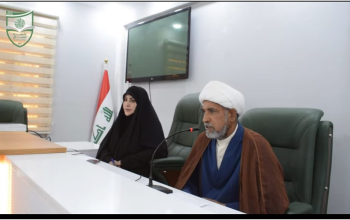
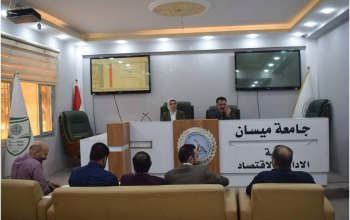
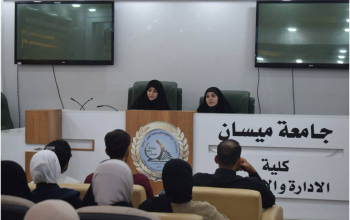
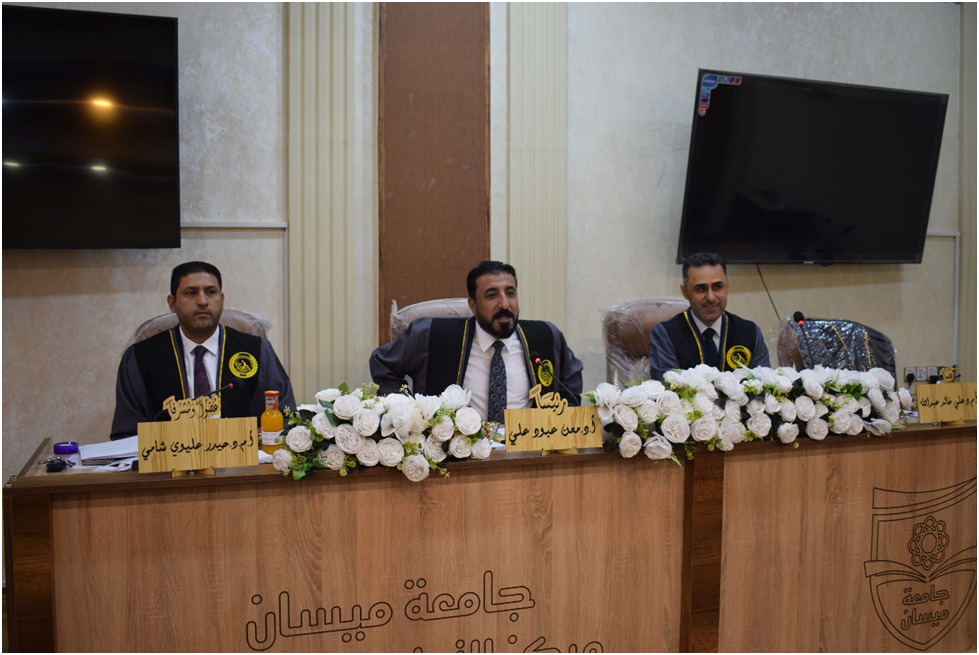
A master thesis entitled “Monetary Policy Discipline and its Role in Attracting Foreign Direct Investment: A comparative study of Egypt and Iraq for the period (2005-2023)” was discussed at the faculty of administration and economics, by student Sumaya Mohammed Saadoun Al-Bahadli, in the continuing education at Misan university.
The discussion committee was consisted of Professor Dr. Maan Ali Aboud Al-Hassani as chairman, and members Prof. Assis. Dr. Ali Khalid Abdullah and Prof. Assis. Dr. Haider Aliwi Shami from Misan University.
Dr. Fouad Farhan Hussein from Tikrit university. Also fans were the president of Misan university, Professor Dr. Adel Maneh Al-Kaabi, the Vice President for Scientific Affairs and Graduate Studies, Professor Dr. Mohammed Kadhim Al-Hashemi. Dean of our faculty of Administration and Economics, Professor Dr. Faiz Abdul-Hassan Jassim Al-Lami, heads of academic departments, a group of lectures from Misan university, and a number of guests.
This study aims to analyze the impact of monetary policy discipline on attracting foreign direct investment in both Egypt and Iraq during the period 2005–2023. A comparative study seeks to reveal the extent to which this impact differs between the two countries due to their differing economic structures and levels of monetary discipline. The study focuses on the most prominent monetary policy tools—interest rates, money supply, and exchange rates—as the key variables influencing foreign investor decisions.
The study depended on a descriptive-analytical approach and a comparative methodology to examine economic and monetary developments in both countries. It also utilized an econometric approach to measure the strength and direction of the relationship between monetary policy variables and foreign direct investment flows.
The results showed that monetary discipline significantly contributes to enhancing investor confidence and improving the investment climate. However, the magnitude of this impact varies between Egypt and Iraq depending on the degree of stability of their monetary policies and the structure of their economies.
The study recommends strengthening the independence of monetary authorities, improving monetary policy tools, and stabilizing inflation and exchange rate rates, which would contribute to increasing the attractiveness of the investment environment in both countries, particularly in Iraq, which still needs further monetary and institutional reforms to achieve higher levels of foreign direct investment flows.