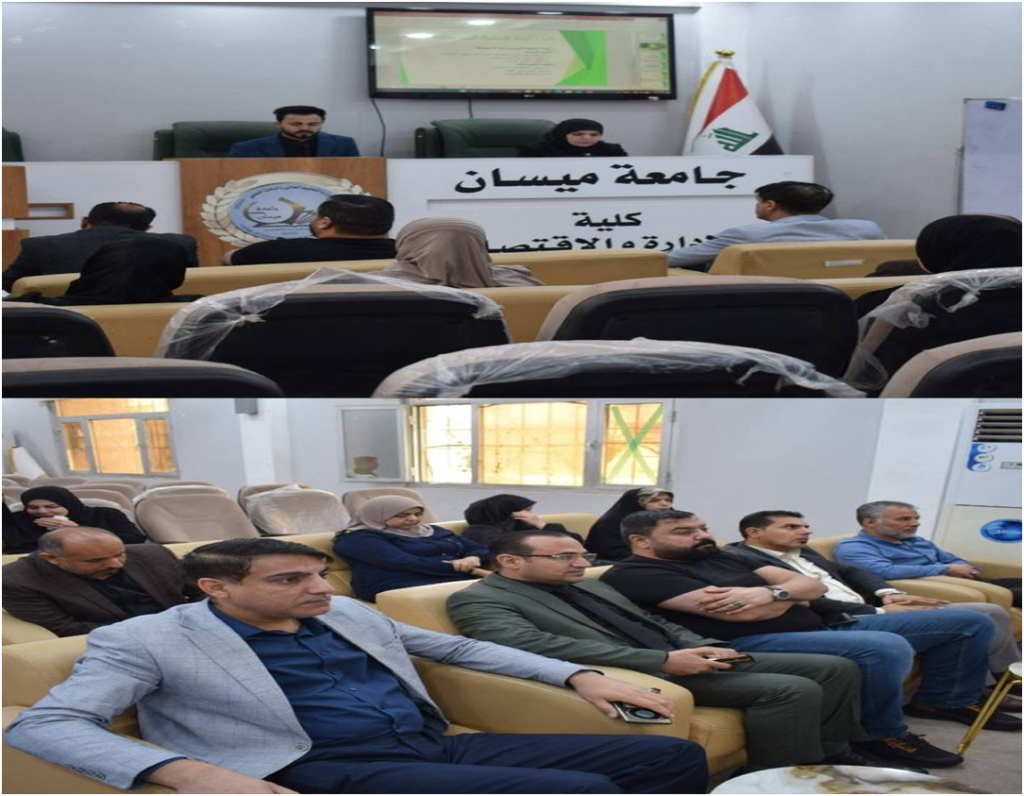
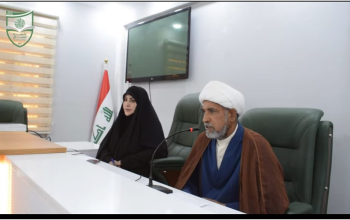
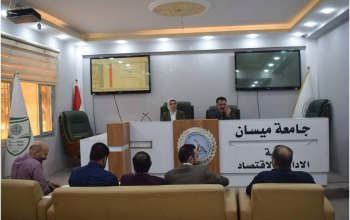
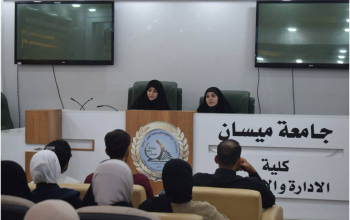
Under the patronage of the President of Misan University, Professor Dr. Adel Maneh Dakhel, and under the supervision of the Dean of the College of Administration and Economics, Professor Dr. Faiz Abdul Hassan Jassim Al-Lami, the Continuing Education Unit at the faculty organized a training course on (Dimensions of Sustainable Development and its Most Important Areas), in the seminar hall, which lasted for three days, and was presented by:
Dr. Rawa Yahya Khalaf
Assist.Lec. Saif Ali Hammadi
The course aims to raise awareness among participants about the importance of sustainability in various fields, and to enhance their ability to adopt sustainable strategies that serve the environment, the economy and society.
The course addressed a range of important topics, most notably: the concept of sustainable development and its shift from merely “protecting the environment” to a comprehensive system that ensures a quality of life for current and future generations; the integrated three dimensions, through an analysis of the “golden triangle” of sustainability (economic, social, and environmental dimensions); and how to achieve a balance between economic growth and resource conservation, in addition to reviewing the Sustainable Development Goals (SDGs).The seventeen SDGs of the United Nations, and the mechanisms for implementing them on the local level, as well as a statement of the strategic importance of sustainability in achieving financial stability, promoting social justice, and protecting ecosystems.
The course, in its practical and analytical aspects, focused on a number of key areas, including:
Achieving strategic balance through mechanisms that balance economic profitability, social justice, and the protection of ecosystems without favoring one over the other.
The transition towards a green economy involves reviewing ways to adopt environmentally friendly financial and administrative policies, and moving towards diversifying income sources and reducing dependence on a rentier economy.
Enhancing the efficiency of national resource management by reducing material and human waste, and adopting the concepts of “responsible consumption and production” to address the challenges of water scarcity and climate change.
The role of governance and digital transformation in linking sustainability with administrative transparency, which contributes to reducing paperwork and enhancing the efficiency of institutional performance in government departments.
The session concluded with the formulation of a set of strategic recommendations aimed at strengthening the path of sustainable development in Iraq, most notably:
Activating the national strategy by aligning development plans in various ministries with the goals of Vision 2030, to ensure a gradual transition towards a diversified economy.
Investing in renewable energy by encouraging the transition to clean energy to reduce carbon emissions and address environmental and climate problems.
Adopting integrated water resources management, through the use of modern irrigation techniques and the protection of water bodies to confront the water scarcity crisis.
Integrating sustainability concepts into education, by including them in university curricula and scientific research, including environmental accounting.
Supporting green entrepreneurship by providing facilities for youth projects based on waste recycling or environmental solutions, which contributes to reducing unemployment rates and strengthening the national economy.