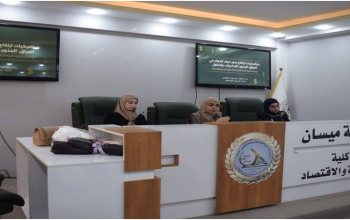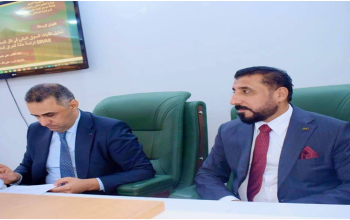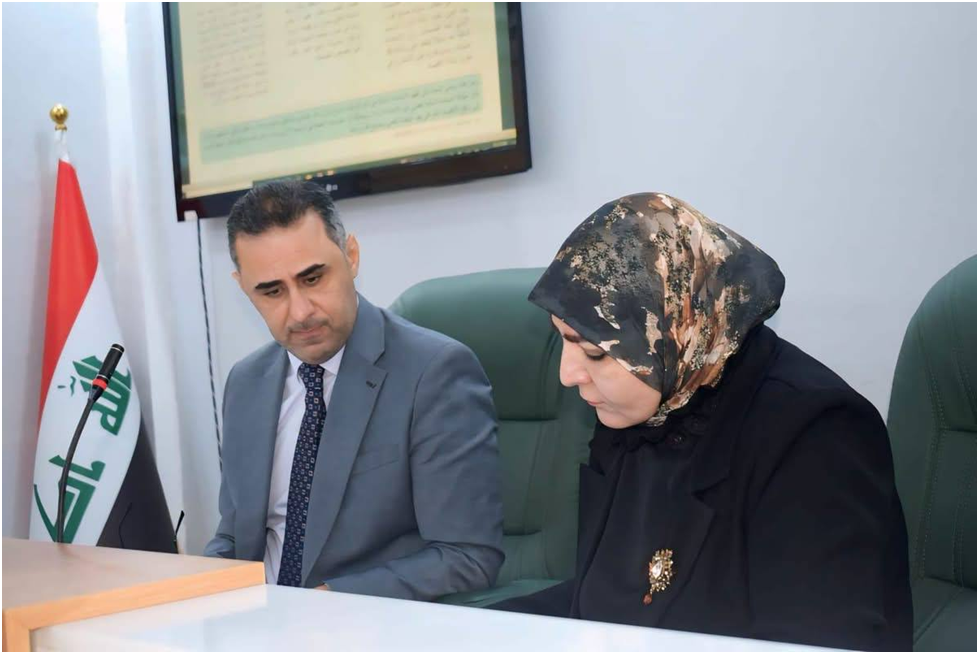
The Department of Business Administration/Investment and Finance Management at the Faculty of Administration and Economics, University of Maysan, organized a scientific seminar to discuss a master’s thesis proposal entitled: “Assessing Financial Sustainability in Iraq: Using a ModelDSGE combined with the Financial Reaction Function for the period (2005–2024)
For the student Mustafa Raad Abdul-Amir. The seminar discussion committee consisted of:
Dr. Zainab Khalil Hashem (Chairman).
Dr. Makki Qasim Ka’eiber (Member).
Dr. Ali Khalid Abdullah (Member and Supervisor).
The researcher began the episode by presenting the problem of his study, which stems from a main question: “Is the fiscal policy in Iraq for the period (2005–2024) characterized by a sustainable behavior that responds to the accumulation of public debt, or does it follow an unsustainable pattern that exacerbates the fragility of public finances in the face of oil price shocks?” He explained that the particularity of the Iraqi economy – as a rentier economy whose budget depends almost entirely on oil revenues – makes its public finances extremely exposed to fluctuations in oil prices and successive shocks, which gives the assessment of its sustainability great importance at the levels of scientific research and decision-making.
The researcher explained that the study adopts an analytical framework that combines two complementary tools: building a dynamic stochastic general equilibrium model (The DSGE for the Iraqi economy includes a structurally modeled oil sector, and integrates a fiscal reaction function based on the Bohn (1998) approach, which links the primary balance to the public debt, so that through them the impact of shocks – especially oil price shocks – on the course of the primary balance and the public debt can be simulated, and the extent to which the conditions for long-term fiscal sustainability are met can be judged.
The session concluded with interventions from committee members, who offered a number of scientific and methodological observations aimed at enriching the study plan and strengthening its standard framework. They emphasized the importance and novelty of the topic within the Iraqi context, and its role in rationalizing and enhancing the sustainability of fiscal policy. This session is part of a series of scientific activities organized by the college to promote the quality of scientific research among graduate students.