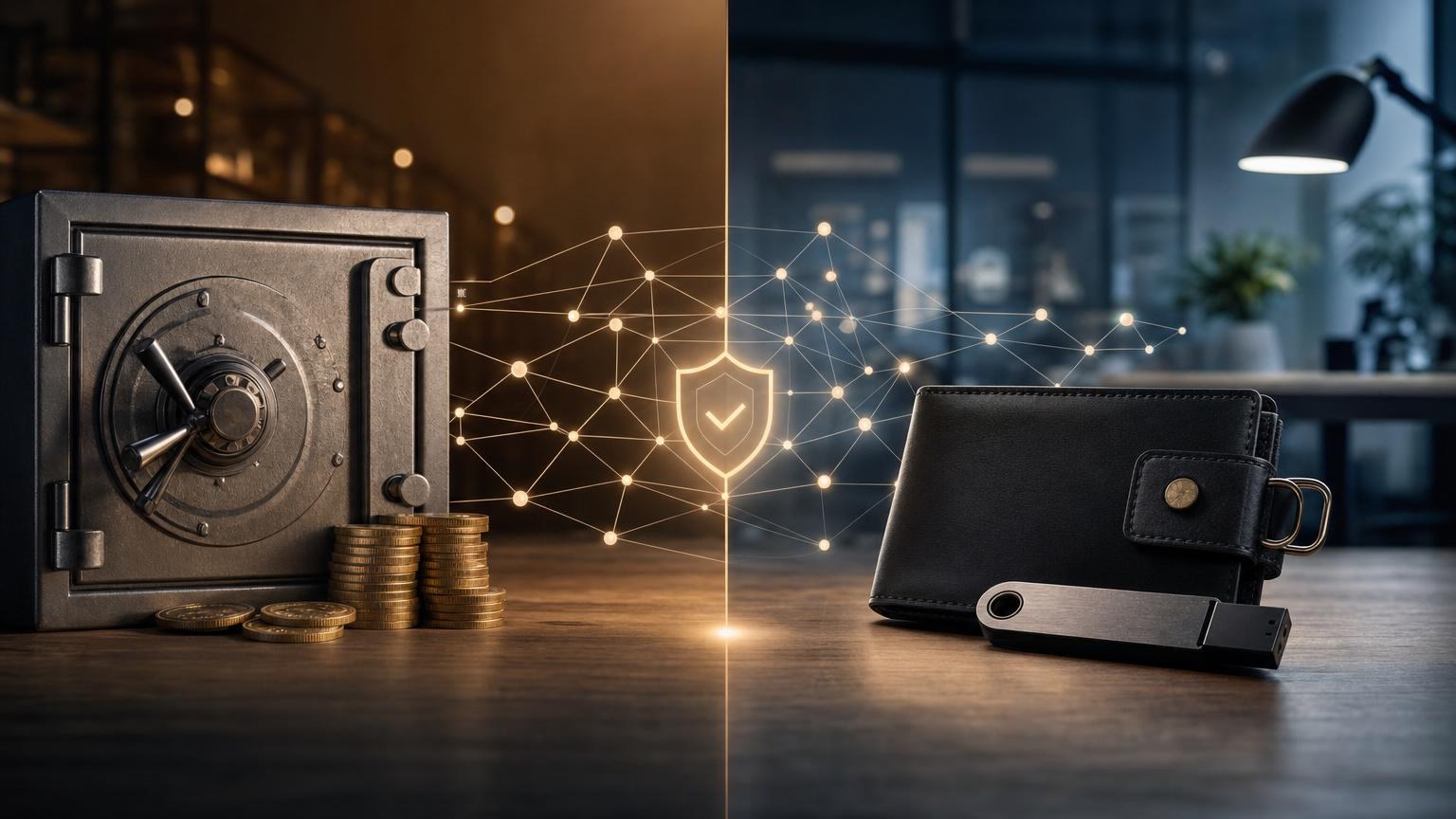
The difference between custodial and non-custodial wallets is not simply “convenience versus security.” It is a decision about who can authorize transactions, who can restore access, which dependencies are acceptable and where operational mistakes become irreversible.
A custodial wallet delegates control of the private keys to a service provider. A non-custodial wallet places that control with the user, although the key may be managed through software, a hardware device or a more complex signing setup. Crypto assets remain recorded on their respective blockchains; the wallet provides the mechanism for accessing accounts and approving transfers. [1]
What Is Actually Being Compared?
The clean comparison is between custody models, not between logos or app interfaces. A polished mobile application may represent a hosted account controlled by a company, a self-custody wallet controlled by its user or even two separate products using different models under the same brand.
The practical test is authorization. If the provider maintains the private keys and processes withdrawals after an account request, the arrangement is custodial. If transactions are signed with keys controlled by the user, it is non-custodial. Password recovery is another useful clue: hosted platforms can often restore account access after identity checks, while a conventional self-custody wallet cannot recreate a lost recovery secret. [2]
Three setups are sufficiently comparable for most real decisions:
- Hosted custodial wallet: the provider controls the keys and exposes balances and transfers through an account.
- Non-custodial software wallet: the user controls the keys through a mobile, desktop or browser application.
- Non-custodial hardware wallet: the user controls the keys through a dedicated device designed to keep signing credentials separated from an internet-connected computer.
The first two differ primarily in custody. The third uses the same self-custody principle as a software wallet but changes the security and operating model enough to deserve separate treatment.
Stable Properties and Dynamic Conditions
Some properties are architectural and relatively stable. Private-key control, the availability of direct transaction signing, responsibility for recovery and dependence on a third party all follow from the custody model.
Other conditions can change without the custody model changing at all. Supported assets and networks, withdrawal availability, service fees, blockchain fees, account limits, confirmation times, regional access and compliance requirements must be checked at the time of the intended operation.
A non-custodial wallet, for example, may technically generate an address for a network while failing to display a particular token correctly. A custodian may support trading in an asset but restrict deposits or withdrawals on a specific network. Neither the word “supported” nor a visible balance proves that a planned route is currently usable from end to end.
Stop Criteria: When an Option Fails Immediately
Before comparing features, remove any model that cannot satisfy a non-negotiable requirement.
- Direct control is mandatory: a hosted custodial wallet fails if the task requires the user to hold the signing keys or independently authorize on-chain transactions.
- Account recovery through support is mandatory: conventional seed-based self-custody fails because a wallet provider cannot reconstruct a recovery phrase it never possessed. Ethereum’s official guidance warns that losing both the recovery phrase and private keys can leave funds unrecoverable. [3]
- The user cannot securely preserve recovery material: self-custody fails until a credible backup process exists. A recovery phrase exposed through phishing, cloud storage, photography or an insecure device can give an attacker control of the associated accounts. [4]
- Direct interaction with decentralized applications is required: a standard hosted balance is insufficient unless the service provides a separate self-custody or compatible signing product. Wallet-based applications generally require the user’s wallet to sign messages or transactions. [5]
- Identity verification or provider-imposed transaction review is unacceptable: a custodial service may not fit. Verification conditions can depend on the operation, location and compliance results, so the current requirements need to be checked before creating a transaction request.
- No reliable way exists to verify the destination network: every option fails for that transfer. Key custody cannot correct an incompatible network, unsupported deposit route or incorrect address.
- Immediate independent access is essential: a custodial account fails if provider downtime, withdrawal controls or account review would make the intended use impossible.
- Frequent signing must occur on a potentially compromised everyday device: a software-only self-custody setup may fail the threat model. A hardware signer can reduce online exposure of private keys, although it does not prevent every form of user error or malicious transaction approval. [4]
Constraint-Driven Decision Matrix
| Criterion | Value for the task | Which options pass or fail | Material limitation | What to verify before deciding |
|---|---|---|---|---|
| Control of signing keys | The user must be able to authorize transactions without provider approval | Non-custodial software and hardware wallets pass; a hosted custodial wallet fails | Key control also transfers backup and security responsibility to the user | Who generates, stores and can export or recover the keys |
| Recoverable account access | Loss of a password or device must be recoverable through an organization | A custodial account may pass; conventional self-custody fails unless the user still has valid recovery material | Provider recovery can require identity checks and does not guarantee immediate access | Recovery procedure, required evidence, regional availability and account restrictions |
| Direct on-chain and application access | The wallet must sign transactions or messages for decentralized protocols | Compatible non-custodial wallets pass; a basic hosted account fails | Signing a malicious request can authorize asset loss even when the private key is never revealed | Network compatibility, contract permissions, transaction simulation and the exact message being signed |
| Low-friction frequent activity | Funds need to be moved regularly with minimal device handling | Custodial accounts and software wallets may pass; hardware wallets may add deliberate operating steps | Convenience can increase exposure to phishing, compromised sessions or rushed approval | Authentication controls, withdrawal safeguards, device security and current service availability |
| Reduced online key exposure | Private keys should remain separated from the general-purpose internet-connected device | A properly used hardware wallet passes most directly; software wallets and custodial accounts use different security assumptions | A hardware device cannot detect every deceptive address, malicious contract or unsafe backup practice | Device authenticity, firmware source, backup process and on-device transaction details |
| Independence from one provider | Access must not depend on a company continuing to operate or approve withdrawals | Portable non-custodial setups pass; custodial wallets fail | Independence from a custodian does not remove dependence on wallet software, network infrastructure or secure key storage | Whether the recovery method works with compatible software and whether the required network remains accessible |
| Asset and network compatibility | The exact asset must be received and sent on the intended blockchain | Any option passes only after current compatibility is confirmed | An asset name may exist on several networks, and support can differ by deposit, withdrawal and wallet implementation | Token contract where applicable, destination network, address format, required memo or tag and withdrawal route |
| Compliance and regional access | The arrangement must be usable under the user’s location and transaction circumstances | Self-custody may reduce account-level dependency; custodial access depends on provider rules | Self-custody does not remove legal, tax or sanctions obligations, which vary between countries | Current local rules, provider eligibility, verification conditions and transaction-specific compliance checks |
| Fees and execution time | The planned transfer must fit the user’s current cost and timing constraints | No model passes automatically | Network demand, provider charges, withdrawal policies and confirmation requirements are dynamic | Current network fee, service fee, quoted amount, expected confirmations and withdrawal status |
How the Three Setups Work in Practice
Hosted Custodial Wallet
The user signs in to an account and instructs the provider to perform an operation. The provider controls the private keys associated with its hosted wallets and may represent customer balances through internal accounting rather than assigning every activity a separate immediate on-chain transaction. The exact implementation varies by provider. [2]
This model suits tasks in which account-based recovery, an integrated trading interface or managed operations matter more than independent signing. The user does not need to preserve a seed phrase for the hosted balance, but must secure the account credentials, authentication methods, email account and recovery channels.
The central limitation is dependency. Withdrawals can be affected by maintenance, security controls, compliance review, regional restrictions or the provider’s financial and operational condition. Legal protections also differ across providers, assets and jurisdictions; crypto balances should not be assumed to carry the protections of an ordinary bank deposit. [6]
Custody therefore replaces one risk concentration with another. The user has less direct key-management burden, but the provider becomes a critical security and access layer.
Non-Custodial Software Wallet
A software wallet generates or imports the keys and signs transactions on the user’s device. The application is an interface to blockchain accounts rather than an institution holding a recoverable account balance. Compatible software can often restore access from the recovery phrase, but only if that phrase remains correct, confidential and available. [7]
This setup is useful for direct transfers, decentralized applications and situations where the user needs control without carrying a separate signing device. It can also be more portable than a hosted account because access is based on keys rather than continued approval from one company.
The trade-off is a broad attack surface. Malware, fraudulent browser extensions, fake wallet websites, compromised cloud backups and impersonated support agents can target the recovery phrase or manipulate what the user signs. No legitimate support interaction requires disclosure of a private key or recovery phrase. [4]
Self-custody should not be confused with anonymity. Public blockchain activity may be visible and can sometimes be connected with identities through transaction history, service records or other data. Bitcoin’s public ledger, for example, permanently records transactions, while addresses are not automatically equivalent to real-world identities. [8]
Non-Custodial Hardware Wallet
A hardware wallet keeps signing keys in a dedicated device and is designed to sign without exposing the private key to the connected computer. This can reduce the consequences of malware on an everyday laptop or phone. [4]
It is most relevant when the requirement is not merely self-custody, but self-custody with reduced online key exposure. That distinction matters for funds that do not need constant movement or for users operating in a higher-risk computing environment.
The device is not a complete security system by itself. The recovery backup can still be stolen, destroyed or entered into a phishing site. A user can also approve a malicious contract interaction or confirm an attacker-controlled address while looking only at the computer screen. Hardware can improve isolation, but safe verification remains a human responsibility. Hardware devices may also be lost, damaged or affected by implementation flaws. [6]
One Changed Constraint, a Different Answer
Consider a user who needs to buy or exchange an asset, make occasional withdrawals and recover access through customer support if a password is lost. A custodial account may fit those requirements, provided the specific asset, network, region, verification process and withdrawal route are currently supported.
Change one condition—require the user to connect directly to a decentralized protocol—and the answer changes. A basic hosted account no longer supplies the necessary transaction-signing capability. A compatible non-custodial wallet becomes necessary.
Now change a different condition: the wallet will hold funds for extended periods and connect only occasionally. A hardware wallet may become more suitable than a software-only wallet because reduced online key exposure has moved ahead of everyday convenience.
Reverse that final condition and require rapid, repeated transactions from a phone. The hardware workflow may become too cumbersome, while a carefully secured software wallet or custodial account may better match the task. That does not make either one inherently safer; it means the operational requirement has changed.
A split setup is also possible. An operational balance can be separated from funds that do not require frequent access. This limits how much one compromised account, device or signing session can expose, but it adds backup complexity and creates more addresses and transfer steps to verify.
After identifying the required custody model and network, check the currently available exchange routes before planning the transfer. Availability may vary by asset, network, direction and compliance outcome.
Risks That the Custody Choice Does Not Remove
Wrong addresses remain dangerous. On networks such as Ethereum, a confirmed transfer cannot normally be reversed by a central administrator. If funds are sent to an incorrect address, recovery may depend entirely on the recipient’s cooperation or on whether a receiving service can assist. [3]
Wrong-network transfers remain an operational hazard. The sender must match the withdrawal network with the network accepted by the destination. Similar address formats do not prove compatibility. Check the full route, including the asset, blockchain, token contract where relevant, destination address and any required memo or tag.
Phishing targets both models. Custodial users can be tricked into surrendering passwords, authentication codes or approving withdrawals. Self-custody users can be directed to fake wallet interfaces, malicious applications or fraudulent signing requests. Bookmarking verified wallet pages and refusing to disclose recovery secrets reduce specific attack paths but cannot replace transaction review. [4]
Volatility is independent of storage architecture. Moving an asset from an exchange account to a hardware wallet does not change its market exposure. Crypto assets can experience substantial and unpredictable price changes, and a custody decision should not be treated as a return forecast. [9]
Local rules still apply. Self-custody does not automatically remove reporting, sanctions, tax or other legal obligations. Custodial services may impose additional eligibility and verification requirements based on their policies and the relevant jurisdiction. These conditions require current, location-specific checking rather than assumptions based on the wallet category.
Final Checks Before Committing Funds
The custody model can be chosen from stable requirements, but the actual transaction should wait until its dynamic parameters are verified.
- Confirm who controls the private keys and whether a separate product from the same brand uses a different custody model.
- Check that deposits and withdrawals are currently enabled for the exact asset and network, not merely that the asset appears in an interface.
- Verify the destination address, network and any required memo or tag independently before signing.
- Review the displayed amount, provider charges, network fee and expected confirmation conditions at the moment of transfer.
- Clarify current identity-verification and compliance requirements before creating an application or transaction request.
- For self-custody, test the recovery process without exposing the recovery phrase or entering it into an untrusted device.
- For custodial storage, examine account recovery, authentication, withdrawal controls and the legal entity serving the user’s location.
- For a new route or address, consider whether a small initial transfer is operationally appropriate before moving the intended remainder.
The decisive question is not which wallet type wins. It is which failure the task can tolerate: dependence on a custodian, or direct responsibility for keys and recovery. Once that constraint is explicit, convenience, hardware format and interface design become secondary filters rather than substitutes for the custody decision.


